Joro Spiders in Georgia: Are They Dangerous and Should You Remove Them?
Walk through a Georgia yard in early fall and you may suddenly find yourself facing a web large enough to stretch between two trees—or across the entire porch. Sitting in the middle is a bright yellow, black and red spider that looks like it belongs somewhere far more exotic than Middle Georgia.
That spider is probably a Joro. They are large, colorful, non-native orb-weavers that have become increasingly familiar across Georgia. Their size and enormous golden webs can be startling, but their appearance is much more dramatic than the risk they pose to people.
The quick takeaway: Joro spiders are not considered a significant threat to people or pets. They are reluctant to bite and usually remain outdoors. The biggest problem for most homeowners is the size and location of the web—not an aggressive spider attack.
What Is a Joro Spider?
The Joro spider, scientifically known as Trichonephila clavata , is a large orb-weaving spider native to East Asia. It was first confirmed in Georgia in 2014 after sightings began around 2013. Researchers believe the species probably arrived in shipped goods or a cargo container.
Joros have since spread through Georgia and into other parts of the Southeast. Their ability to tolerate urban areas, busy roads, vibration, colder temperatures and a variety of outdoor habitats has helped them become firmly established.
They are still considered introduced and non-native. Scientists continue to study their long-term effect on native spiders, insects and local food webs. Current research, however, has not shown that Joros are the aggressive ecological takeover artists some early headlines suggested.
Why Joro Spiders Become So Noticeable in the Fall
Joro spiderlings emerge in spring and remain comparatively small through the early part of the year. They grow throughout the summer. By late summer and early fall, adult females and their webs have become large enough that homeowners can hardly miss them.
After mating, females produce egg sacs that remain protected through the winter. The adult spiders eventually die as cold weather settles in, and the next generation emerges when conditions warm again.
Young Joros can disperse through a process called ballooning. The spiderlings release strands of silk that catch the wind and carry them to a new location. Adult Joros do not sprout wings or fly through the air, despite the “flying spider” descriptions sometimes used in headlines.
Why do several appear together? A good web-building location may provide plenty of anchor points, shelter and flying insects. Multiple spiders can build close together, creating what looks like one enormous, tangled web system.
How to Identify a Joro Spider
Color, body size, web structure and the time of year all help with identification. The enormous, brightly colored spider that gets most of the attention is the adult female.
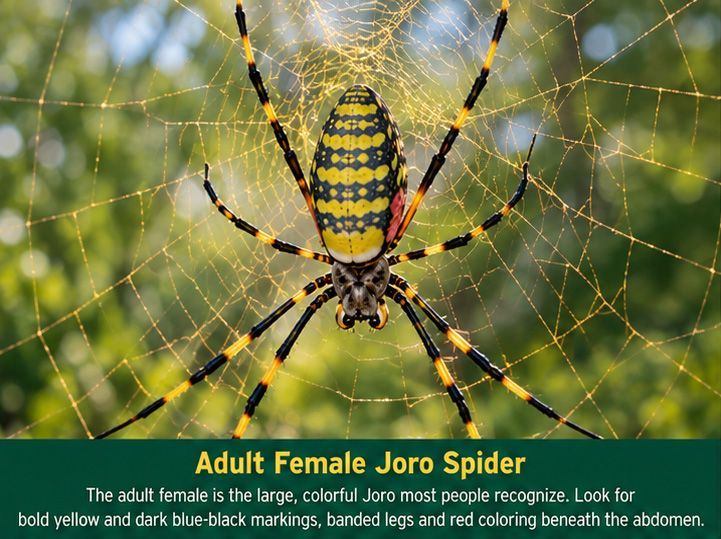
Large, bright and easy to see
An adult female may measure roughly three to four inches across when the legs are included. She has bold yellow and dark blue-black markings, banded legs and red coloring on the underside of the abdomen.
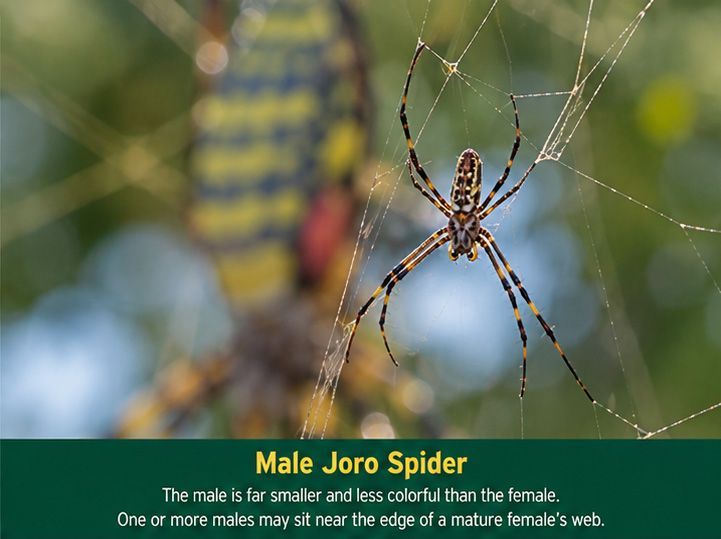
Much smaller and less colorful
Male Joros are dramatically smaller than females and usually brown or muted in color. One or more males may be found near the edge of a female’s web and are easy to overlook.
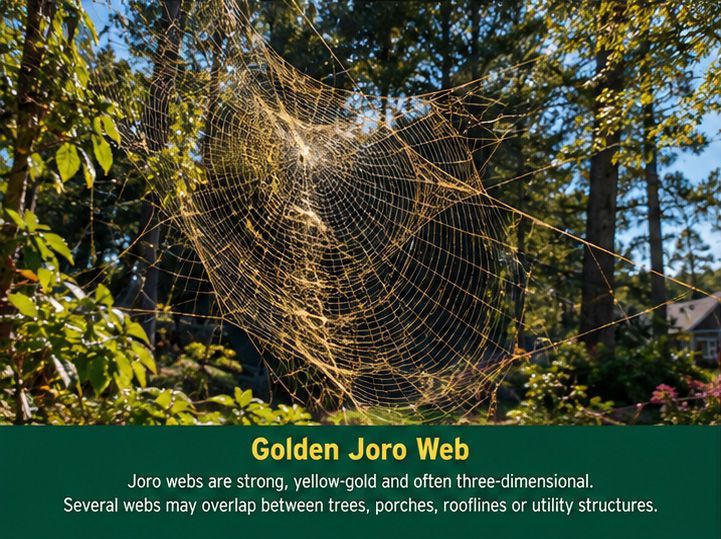
Golden, deep and three-dimensional
Joros build strong yellow-gold webs that can include several layers of silk. Webs may stretch between trees, shrubs, utility lines, porches, decks, rooflines and other elevated anchor points.
Most obvious in late summer and fall
Young spiders can be present earlier, but the mature females and largest webs are usually most noticeable as summer gives way to fall.
Use the editable photo guide below to compare an adult female, an adult male, a typical golden web and a native yellow garden spider.
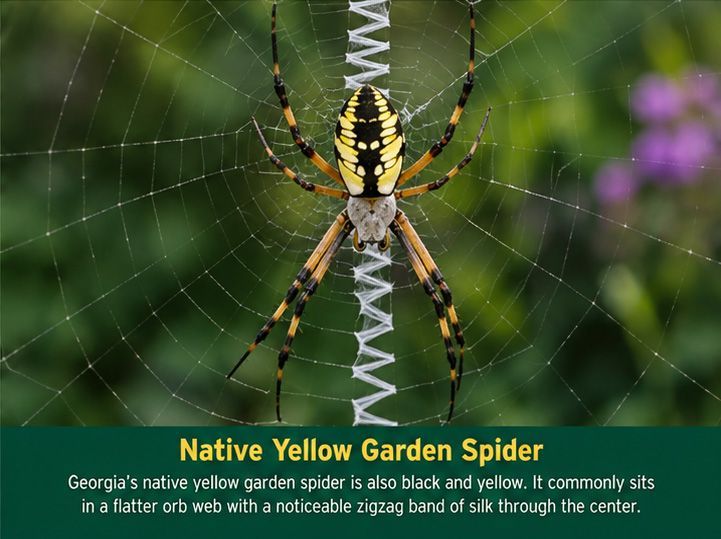
Identification tip: Do not rely on size or the colors black and yellow alone. Georgia has several native orb-weavers. A clear photograph showing the top and underside of the spider, along with the web, is much more useful than a quick description.
Are Joro Spiders Dangerous?
Joro spiders have venom, as nearly all spiders do, because they use it to immobilize their prey. That does not mean they are dangerous to people. University of Georgia researchers describe Joros as unusually timid, docile spiders that are more likely to freeze, retreat or remain still than bite.
A bite is most likely only if a spider is trapped against the skin, squeezed or deliberately handled. Joros are not considered a meaningful threat to people or pets, and most homeowners can safely leave an out-of-the-way spider alone.
Joros aggressively chase people
Joros generally remain in or near their webs. Their usual response to disturbance is to freeze, retreat or move away.
Their size is the scary part
A mature female and her web can look intimidating, but appearance does not equal aggression or medical danger.
Adult Joros fly toward people
Adult spiders do not fly. Tiny spiderlings may disperse on windborne silk through a natural process called ballooning.
They normally live outside
Joros build outdoor webs. One may accidentally enter a garage, porch or building, but they are not typical indoor-infestation spiders.
Do not handle a Joro to test whether it will bite. Leave the spider alone or remove it from a comfortable distance. Seek medical advice if any suspected spider bite causes severe pain, extensive swelling, spreading redness or another concerning reaction.
What the Latest Georgia Research Says
One of the biggest questions about Joro spiders has been whether they compete with native orb-weavers for the same food. A 2026 study from researchers at the University of Georgia and Valdosta State University used DNA analysis to examine prey found in spider digestive tracts.
The researchers collected 213 female Joro spiders from 33 locations and compared their diets with several native orb-weaving species collected across Georgia and South Carolina.
The study found that Joro diets were different from those of the native spiders. Joros consumed at least 26 prey groups that were not detected in the native spider diets examined. Much of their food consisted of small flies and other insects, including leafhoppers and aphids.
Researchers also did not find a significant change in the diets of native orb-weavers at locations where Joros were present. That suggests strong competition for food may not be occurring, at least in the populations and locations included in the study.
What that does—and does not—mean: The study offers reassuring evidence about direct food competition. It does not prove that Joros have no ecological effect. Scientists are still studying their web placement, population density, range expansion and long-term relationship with native species.
Joros eat many insects people consider pests, but that does not make it wise to introduce, move or encourage a non-native spider. The practical approach is to understand what is present, avoid unnecessary pesticide use and manage individual webs when their location creates a nuisance.
Should You Remove a Joro Spider or Leave It Alone?
The answer usually depends on where the web is located. A Joro high in a tree or along a wooded property edge may not require any action. A web stretched across a doorway, walkway, play area, porch or outdoor seating space is a different matter.
| What you find | Practical response |
|---|---|
| One web high in a tree or away from people | Leave it alone if it is not interfering with the use of the property. |
| Web across a doorway, walkway or porch | Remove the web and spider individually from a safe distance. Recheck the area because rebuilding may occur. |
| Several webs around outdoor lights | Reduce unnecessary nighttime lighting and address the insects gathering around those fixtures. |
| Web attached to power lines or a high roofline | Do not climb or work near electrical lines. Leave it alone or contact an appropriate professional if the location creates a genuine hazard. |
| Recurring webs around several high-use areas | Review lighting, vegetation, web anchor points and overall insect activity. Consider a professional exterior pest inspection. |
| A spider that entered a garage or building | Guide or capture it without direct handling and release it outside, or use a vacuum when necessary. |
How to Remove an Individual Joro Web
- Choose a clear escape route. Do not stand on a ladder or position yourself where a sudden movement could cause a fall.
- Use a long-handled broom or web-removal tool. Work from a comfortable distance rather than grabbing the web or spider.
- Remove the main web and anchor strands. Leaving the outer support lines can make rebuilding easier.
- Relocate or remove the spider. Do not handle it with bare hands.
- Check the site again. A spider may rebuild in the same location if the anchor points and insect activity remain attractive.
Avoid Blanket Insecticide Spraying
- Do not spray the entire yard simply because several Joros are present.
- Broad spraying can kill pollinators, native spiders and other beneficial insects along with the target spider.
- Removing beneficial predators may allow other insect problems to increase.
- Never spray near people, pets, food areas, water, pollinator plants or property boundaries contrary to the product label.
- Always follow the complete pesticide label or use a properly licensed pest-control professional.
How to Reduce Joro Webs Around Your Home
No practical treatment can prevent every outdoor spider from crossing your property. You can, however, make high-use areas less attractive and remove the conditions that repeatedly support large webs.
- Turn off unnecessary exterior lights when they are not needed.
- Consider warm amber or yellow outdoor bulbs that attract fewer flying insects than bright white lighting.
- Trim branches, vines and dense vegetation away from porches, walkways, decks, rooflines and outdoor seating areas.
- Remove webs promptly from frequently used areas before spiders become firmly established.
- Repair damaged screens and seal gaps around doors, windows, vents and utility openings.
- Keep porch corners, eaves, railings and outdoor furniture reasonably clean and free of old webbing.
- Address the insects gathering around lights, doors, trash containers and outdoor living spaces.
Spider activity often follows food. If moths, flies, mosquitoes and other insects repeatedly gather around the same part of the home, spiders are likely to follow.
When to Contact Pest Magic
A single Joro in an out-of-the-way tree usually does not require professional pest control. Assistance may make sense when webs repeatedly cover entrances, porches, decks, pool areas, commercial walkways or other spaces that people need to use.
Consider contacting Pest Magic when:
- webs repeatedly return around doors and heavily used walkways;
- several spider species are building around the structure;
- outdoor lights attract heavy nighttime insect activity;
- spiders and webs are appearing around eaves, windows and rooflines;
- you are unsure whether the spider is a Joro or another species;
- webs are creating a persistent nuisance for customers or residents; or
- you want a broader exterior pest-control and prevention plan.
The goal should be practical management—not a promise to eliminate every outdoor spider in Georgia. Pest Magic can evaluate the property, identify contributing insect activity and recommend a targeted approach for the areas that matter most.
Frequently Asked Questions
Are Joro spiders poisonous?
Joros are venomous rather than poisonous, meaning they use venom to subdue prey. University of Georgia researchers describe them as relatively harmless to people and pets, and bites are considered unlikely unless a spider is trapped or handled.
Do Joro spiders fly?
Adult Joros do not fly. Tiny spiderlings can release silk that catches the wind and carries them to a new location. This behavior is called ballooning.
Do Joro spiders come inside homes?
Joros are outdoor orb-weavers and do not normally establish indoor infestations. One may accidentally enter a garage, porch or building, but kitchens and wall voids are not their typical habitat.
Will Joro spiders disappear in winter?
Adult spiders die as colder weather settles in, but their protected egg sacs remain. Spiderlings emerge during the following spring and begin the annual cycle again.
Are Joro spiders killing Georgia’s native spiders?
Their full ecological impact is still being studied. A 2026 diet study did not find evidence of strong food competition with the native orb-weavers examined, but researchers continue to investigate other possible effects.
Should I kill every Joro spider I see?
No. An isolated Joro away from high-use areas can usually be left alone. Individual spiders and webs can be removed when they interfere with doors, walkways, porches or outdoor living spaces.
Can Pest Magic help with recurring spider activity?
Yes. Pest Magic can evaluate recurring webs, exterior insect activity, lighting, vegetation and other conditions that may be attracting spiders around frequently used areas of the property.
Are Spider Webs Taking Over Your Porch?
One Joro high in a tree may not be a problem. Webs repeatedly appearing across doors, walkways, porches and outdoor living areas are another story.
Pest Magic can inspect recurring spider and insect activity, identify the conditions attracting them and recommend a practical exterior pest-control plan for your property.
We proudly serve Macon, Forsyth, Griffin, Barnesville, Bolingbroke and surrounding Middle Georgia communities.